
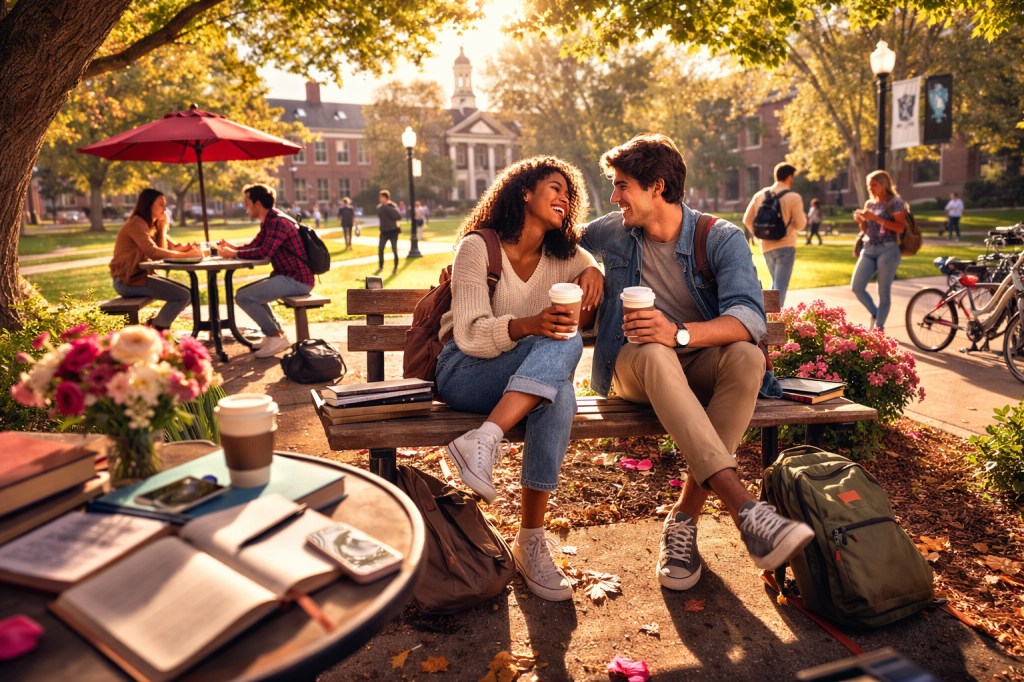
It’s rare to hear anyone say they “met someone on campus” anymore. The first move usually happens on a screen — a story reaction, a DM, a streak that somehow keeps going long enough to become a conversation. You see it everywhere: students in the LRC glancing between lecture notes and notifications, half in real life and half inside the digital spaces where most connections actually begin.
For a lot of people, that online rhythm is what makes dating feel quicker than it used to. One student, Demola, put it simply: “When everything lives on your phone, there’s no natural pause. You’re texting, sending memes, reacting to stories — it’s a constant drip of presence that makes you feel closer faster than you really are.” What he’s describing isn’t unusual. The speed comes from familiarity being built through fragments — humour, timing, curated posts — long before you meet someone face-to-face.
But he also points out something most people don’t admit: online closeness can be misleading. “You start building a sense of someone through what they choose to show,” he said. “The real test is when you meet physically, and the energy either aligns or it doesn’t.” In his case, it worked. The transition from digital to real life made sense. For others, the shift can feel abrupt.
For many students, the platforms themselves set the tone. Demola explained it in a way that feels accurate for most people our age. “Snapchat is intimacy — real-time updates and unfiltered moments. Instagram is curation — you’re stepping into someone’s whole aesthetic and social world. Apps are different; they feel more transactional.”
It’s a breakdown that shows how much these platforms act as environments rather than tools. Students don’t just talk through them — they date through them.
But not everyone thrives in that kind of space. Matthew, another student, thinks the biggest misconception is that dating at university is easy just because students are constantly around each other. “People assume proximity means compatibility. It doesn’t,” he said. Between deadlines, part-time jobs, and personal stress, the environment doesn’t automatically produce stable relationships.
He’s also one of the few who genuinely prefers meeting people in person: “Online, I feel like I’m operating at half-volume. My humour doesn’t land the same. In real life, you can read someone’s energy instantly — how they look at you, how they respond without thinking. None of that exists online.”
His point is something a lot of students quietly agree with: the digital stage makes some personalities shrink.
For others, the pressure comes from the expectations built into the platforms themselves. Yvonne described this clearly: “There’s this unspoken thing where you’re supposed to always be available. When I’m on placement, I can go hours without touching my phone, and silence gets misread.” She stepped back from dating partly because of that constant demand to perform presence — to reply quickly, to stay visible, to not seem “dry.”
She said she feels more like herself offline. “In person, I’m present and chatty. Online, it’s like you’re managing someone’s expectations while managing your own life.” It’s a sentiment that echoes across campus, even from people who still date actively — the sense that online communication amplifies pressure rather than reducing it.
Taken together, these voices show a reality most students recognise, even if they don’t say it openly: dating hasn’t disappeared, it’s just shifted into a digital rhythm that shapes everything around it. The pace, the pressure, the anticipation — all of it unfolds on screens long before two people sit across from each other in real life.
Students still connect, still build relationships, still navigate all the awkwardness and excitement that comes with it. They’re just doing it in a world where the first spark is more likely to come from a notification than a conversation in a lecture hall.
 UH Student News
Leave a comment